Structural Defense Against ADA Website Lawsuits California Businesses Face
The digital landscape is currently facing a significant legal shift regarding structural code requirements and civil rights compliance. A sharp increase in ADA website lawsuits California courts process has exposed fundamental flaws in how modern web development agencies approach digital accessibility. With the stringent 2026 Department of Justice Title II updates solidifying Web Content Accessibility Guidelines as the definitive standard, businesses can no longer rely on cosmetic fixes to mitigate legal risk. Our technical leadership at Ideary Works analyzes these trends to help organizations understand that true compliance requires structural engineering at the root code level rather than superficial software adjustments.
Understanding the ADA Website Lawsuits California Courts Handle
Under the federal Americans with Disabilities Act and the Unruh Civil Rights Act, commercial websites are increasingly classified as places of public accommodation. Plaintiffs consistently target businesses lacking adherence to WCAG 2.1 or 2.2 AA standards, leading to a massive volume of costly litigation across the state. Because California law allows for statutory damages of four thousand dollars per violation, plaintiff firms employ automated scanning tools to identify easily verifiable source code failures at scale. This reality dictates that structural compliance within the Document Object Model is the only reliable defense against the aggressive legal tactics we observe today.
The Mechanics of Automated Litigation
The mechanics of these legal complaints rely entirely on objective, programmatic failures in website source code. Plaintiff firms utilize basic web crawling scripts to identify missing alternative text attributes, empty navigational links, and invalid ARIA roles across thousands of domains simultaneously. Once these tools detect structural flaws in the HTML, the firm generates a mass-produced legal complaint citing both federal statutes and the state-level Unruh Civil Rights Act. We consistently observe that these lawsuits rarely focus on subjective usability preferences, exploiting instead easily verifiable code failures that automated accessibility validators catch in seconds. Defeating this automated litigation strategy requires an engineering mindset that prioritizes semantic correctness from the initial deployment phase.
The False Promise of Automated Accessibility Overlays
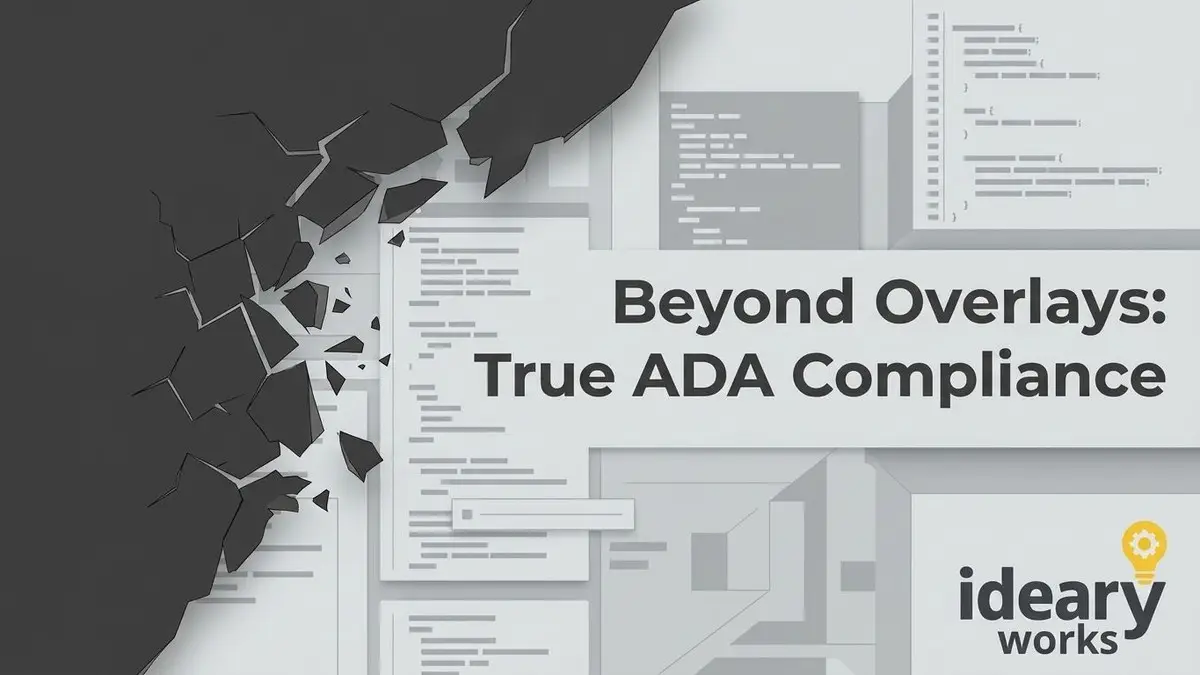
Automated accessibility widgets heavily market themselves as an instantaneous solution to an inherently complex software engineering problem. These tools inject a JavaScript payload that attempts to modify the DOM upon user interaction, artificially masking the underlying HTML structural deficits. However, we know as a matter of technical fact that these plugins routinely fail to interact properly with advanced assistive technology drivers like JAWS or NVDA. When an overlay attempts to hijack the native accessibility tree of the browser, it frequently creates conflicting audio cues and introduces insurmountable navigation barriers for visually impaired users. This reliance on client-side script execution leaves the fundamental accessibility barriers unresolved at the structural level.
Failing the Mootness Dismissal Test
Courts across the jurisdiction are increasingly recognizing that superficial software overlays do not constitute equivalent digital access under the law. We have analyzed numerous cases where judges explicitly rejected mootness dismissal arguments because the defendant relied on an overlay rather than remediating the actual source code. A business remains legally exposed because the automated widget fails to provide a permanently accessible structure independent of third-party script loading times and network reliability. Furthermore, overlay vendors often include clauses in their terms of service absolving themselves of legal liability when their widgets fail to prevent a lawsuit. True legal protection demands structural engineering where the web application itself natively conforms to WCAG guidelines without relying on temporary software bandages.
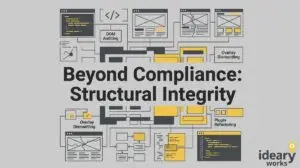
Engineering Structural Compliance in the DOM
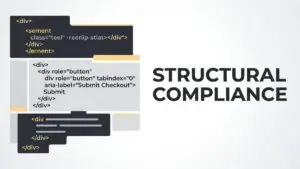
To understand the necessity of our Engineer and Remediate service, we must dissect the fundamental mechanics of semantic HTML construction. Consider a custom dropdown menu built using generic division tags paired exclusively with mouse-specific event listeners like hover or click states. This architecture creates an impenetrable barrier for users relying on keyboard navigation, as generic container elements do not inherently receive browser focus or trigger keyboard events. We solve this structural deficit by implementing native button elements, utilizing explicit tabindex properties where necessary, and writing precise JavaScript handlers for Space and Enter key events. You can immediately test my website to determine if your current dropdown menus and interactive components suffer from these exact keyboard navigation failures.
ARIA Attributes and Screen Reader Behavior
Bridging the gap between raw code and user experience requires a highly sophisticated implementation of Accessible Rich Internet Applications attributes. When a complex visual layout dictates the use of a non-semantic element, developers must manually assign the correct ARIA role, state, and property to construct a logical accessibility tree. For instance, dynamic content updates generated by asynchronous JavaScript requests remain completely invisible to screen readers without the strategic deployment of aria-live regions within the markup. By engineering these polite or assertive live regions directly into the DOM structure, we guarantee that assistive technologies announce critical page updates without disrupting the journey of the user. This granular control over the accessibility tree exemplifies the precision required to engineer truly compliant web applications.
Focus Management and Keyboard Navigation
Another severe structural liability involves the failure to manage keyboard focus accurately within modal dialogs and dynamic overlays. When a user activates a pop-up window, poor web engineering often allows the keyboard focus to escape the modal container and traverse the visually hidden page background. This creates a disorienting and often impossible navigation scenario for individuals utilizing switch devices or sip-and-puff technologies to interact with the browser. Our technical rigor dictates that focus is programmatically trapped within the active modal via JavaScript and returned precisely to the triggering element upon closure. Satisfying these strict WCAG criteria requires methodical state management that automated plugins simply cannot deduce from poorly written markup.
Integrating the Engineer and Remediate Solution
The technical intersection of structural compliance and search engine optimization provides a compelling technical advantage for organizations that invest in source code remediation. Search engine indexing spiders and assistive technologies rely on the exact same logical document structure to interpret the meaning and hierarchy of your digital content. By replacing nested generic containers with precise header tags, defined main landmarks, and logical navigational elements, we drastically improve your organic search indexing potential. Investing in code-level accessibility inherently transforms your website into a highly optimized technical asset that performs better across all measurable digital metrics. Semantic engineering proves that accessible code is simply superior code from an architectural standpoint.
Leveraging the IRS Section 44 Tax Credit
The financial implications of proper structural remediation become highly favorable when businesses utilize available federal tax incentives designed for accessibility improvements. The IRS Section 44 Disabled Access Credit allows eligible small businesses to offset the costs associated with upgrading their digital infrastructure to meet stringent ADA requirements. This federal tax credit directly subsidizes the cost of retaining a dedicated technical partner to audit, rebuild, and systematically maintain your codebase. We guide our clients through this financial mechanism to ensure that achieving rigorous technical compliance remains a sound business investment rather than an overwhelming fiscal burden. By leveraging Section 44, companies can fund the deep structural fixes necessary to defeat litigation permanently.
Continuous Technical Maintenance
Maintaining continuous compliance requires an ongoing commitment to structural integrity as modern web technologies and user expectations rapidly evolve. Every time a marketing team adds new content or a software developer deploys a feature update, there is a distinct risk of introducing new DOM structure violations. Our continuous monitoring and maintenance protocols analyze every codebase modification against the latest WCAG 2.2 guidelines to prevent costly regression. We treat digital accessibility as a foundational code requirement that must be actively preserved through methodical testing and strict engineering oversight. This uncompromising dedication to structural preservation solidifies your long-term defense against predatory legal action.
Taking Action for Defensible Protection
The transition from a non-compliant liability to a robust, legally defensible platform requires a partner capable of executing precise structural transformations. California businesses must reject the false promises of automated widgets and embrace the rigorous, data-driven engineering approach necessary to protect their digital assets. Addressing these vulnerabilities at the root code level is the only way to satisfy federal mandates and eliminate the threat of Unruh Civil Rights Act litigation. We invite you to get my free homepage accessibility review to understand the precise structural vulnerabilities hiding within your current DOM architecture. By partnering with our engineering leadership at Ideary Works, you will secure a transparent, highly optimized, and structurally flawless digital platform.