Understanding Accessibility Overlay Failures in Web Code
The digital landscape is currently experiencing a significant shift in regulatory expectations regarding web compliance, making it critical to understand accessibility overlay failures. As the Department of Justice enforces the 2026 Title II updates and plaintiffs increase Unruh Civil Rights Act litigation, businesses can no longer rely on cosmetic solutions to meet federal and state mandates. Our collective technical rigor at Ideary Works treats digital accessibility as a foundational engineering requirement rather than an afterthought, ensuring that structural code satisfies stringent legal and functional criteria. To truly mitigate risk and leverage financial benefits like the IRS Section 44 Disabled Access Credit, organizations must recognize why automated plugins fundamentally fail to provide equal access.
The Technical Reality of Accessibility Overlay Failures
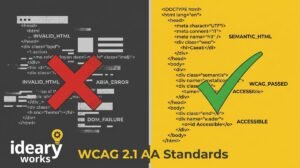
When analyzing the technical shortcomings of automated widgets, we must first examine the underlying Document Object Model (DOM) and how these tools interact with it. Accessibility overlays attempt to use JavaScript injections to dynamically alter the user interface, but they consistently fail to restructure the raw HTML necessary for screen readers to parse information accurately. This superficial approach means that keyboard navigation sequences remain broken, leaving visually impaired users trapped in endless focus loops or unable to bypass repetitive content blocks. True compliance with WCAG 2.2 AA standards requires a deeply integrated structural mindset, where semantic HTML dictates the behavior of assistive technologies precisely and predictably.
How Plugins Ignore Native DOM Structure
A standard automated plugin scans a webpage upon load and attempts to guess the purpose of various elements, applying temporary fixes that frequently conflict with native browser behaviors. Because these widgets operate as a superficial layer on top of the existing codebase, they cannot resolve fundamental architectural flaws like missing form labels, incorrect heading hierarchies, or inaccessible modal dialogs. If a developer uses a generic div tag to create a button without adding the appropriate role attribute or tab index, the overlay might visually enhance the element while leaving it completely invisible to a screen reader. This technical discrepancy forms the root cause of countless legal challenges, as plaintiffs easily demonstrate that the core user experience remains entirely inaccessible despite the presence of an expensive automated widget.
Semantic HTML Versus JavaScript Injection
The distinction between writing semantic HTML and relying on post-load JavaScript injection is the difference between structural engineering and applying a temporary bandage to a cracked foundation. Semantic tags such as nav, main, and article provide inherent contextual landmarks that assistive devices use to build an auditory map of the page for users relying on screen readers. When businesses depend on third-party JavaScript to retrofit these landmarks after the page has rendered, they introduce significant latency and synchronization issues that disrupt the cognitive flow of the user. We systematically construct websites using native semantic architecture to ensure that the code itself communicates its intent perfectly, rendering fragile JavaScript overlays entirely obsolete and protecting businesses from compliance audits.
Legal Precedents and the Unruh Civil Rights Act
The intersection of technical web development and the current legal landscape clearly demonstrates that courts do not accept automated solutions as a valid defense against discrimination claims. Recent surges in litigation under California statutory frameworks, specifically the Unruh Civil Rights Act, highlight a pattern where plaintiff firms actively target websites utilizing well-known overlay products. Judges consistently reject arguments based on the mere installation of these plugins, noting that the underlying code still prevents users with disabilities from independently navigating the site and completing transactions. By examining mootness dismissals and recent settlement trends, it becomes mathematically evident that investing in structural code compliance is the only reliable method to eliminate legal exposure and protect an organization’s digital assets.
Automated Tools and Mootness Dismissals
In legal defense strategies, companies often attempt to claim mootness by rapidly installing an overlay after receiving a demand letter, arguing that the site has been fixed and the lawsuit is no longer necessary. However, technical expert witnesses routinely dismantle this defense by running automated accessibility tests and manual audits that reveal persistent WCAG violations beneath the cosmetic widget layer. Because the underlying DOM structure remains unchanged and continues to fail established assistive technology tests, courts refuse to dismiss the cases, recognizing that the temporary fix provides no structural permanence. Businesses utilizing this reactionary strategy ultimately face both the ongoing costs of litigation and the inevitable expense of rebuilding their website to meet the required technical specifications.
Why Widgets Fail Assistive Technology Tests
Assistive technologies, including the JAWS and NVDA screen readers, interact directly with the accessibility application programming interface provided by the operating system, which derives its data from the browser’s parsed DOM. Overlays attempt to intercept and modify this data stream, often overriding the personalized settings that users with disabilities have carefully configured on their own devices. This interference actively degrades the user experience by forcing proprietary navigation menus or redundant auditory feedback loops that confuse rather than assist the end user. When tested by actual users who rely on these assistive tools daily, overlay-enhanced websites frequently score worse in usability metrics than standard websites, providing irrefutable data that these products fail their primary objective.
Achieving Structural Compliance Without Shortcuts
To guarantee that a digital property meets all WCAG 2.1 and 2.2 AA requirements, development teams must abandon shortcuts and embrace a methodology centered on analytical precision and structural integrity. This process begins at the foundational level by auditing the existing codebase to identify precise failure points, such as insufficient color contrast ratios, missing alternative text descriptions, and illogical focus order. We then meticulously rewrite the component architecture, ensuring that every interactive element possesses the necessary states and properties required for universal operability. This data-driven approach guarantees that the final product not only withstands the scrutiny of automated compliance scanners but also provides a seamless, equitable experience for all users regardless of their physical abilities.
Implementing ARIA Labels and Keyboard Navigation
Accessible Rich Internet Applications (ARIA) attributes serve as vital communication bridges when native HTML semantics fall short in describing complex, dynamic user interfaces. However, ARIA labels must be implemented with surgical precision, as incorrect usage can inadvertently hide crucial information from screen readers or create conflicting auditory signals. For example, applying a hidden attribute to a parent container while attempting to focus a child element within it will cause the screen reader to fail silently, completely breaking keyboard navigation sequences. Our technical protocol requires strict validation of all ARIA implementations and comprehensive manual testing to ensure that the logical tab order exactly mirrors the visual flow of the application.
The Economic Impact of Proper Code Structure
Beyond the immediate avoidance of legal penalties, building a website with fundamentally sound accessibility practices directly impacts an organization’s economic performance and search engine visibility. Search engine crawlers interpret web pages much like screen readers do, relying heavily on semantic HTML, clear heading hierarchies, and descriptive alternative text to understand the content and rank it appropriately. Therefore, when you eliminate structural flaws by restructuring the DOM, you simultaneously optimize the platform for algorithmic indexing, leading to improved organic traffic and higher conversion rates. This dual benefit transforms the compliance process from a perceived financial burden into a strategic investment that generates measurable returns while completely satisfying federal accessibility mandates.
Maximizing the IRS Section 44 Tax Credit
The federal government incentivizes businesses to adopt proactive compliance strategies by offering the IRS Section 44 Disabled Access Credit, which covers a significant portion of structural accessibility upgrades. Unlike subscription fees for superficial automated plugins, the costs associated with permanently auditing and remediating your website’s underlying code qualify directly for this tax advantage. We partner with clients to document every technical modification, from rebuilding faulty form inputs to correctly mapping DOM elements, ensuring that the engineering work strictly aligns with IRS documentation requirements. By leveraging this financial mechanism, companies can achieve rigorous WCAG compliance and eliminate their litigation exposure at a fraction of the anticipated capital expenditure.
Proper web architecture also reduces long-term maintenance costs and minimizes technical debt for development teams. When a codebase is clean and structurally compliant from the start, engineers do not have to continuously patch broken features or integrate fragile third-party scripts that conflict with core functionalities. The initial investment in writing semantic, accessible code yields a streamlined development lifecycle where new pages and updates inherently inherit the correct accessibility properties. Organizations that prioritize this structural engineering mindset ultimately spend less time managing unpredictable software glitches and more time focusing on their primary business objectives.
Safeguarding Against Accessibility Overlay Failures
The definitive path to safeguarding an enterprise against ADA litigation involves a proactive, code-level transformation rather than relying on flawed software subscriptions. By understanding the profound limitations and legal liabilities associated with these automated widgets, organizations can redirect their resources toward permanent web improvements that satisfy 2026 DOJ Title II updates. Furthermore, investing in proper engineering methodologies guarantees a robust platform that provides an inclusive experience for every single visitor. We strongly encourage technical leaders to review their current compliance posture and get my free website audit to establish a secure, rigorously tested digital infrastructure.