
Resolving ADA Overlay Litigation Risk
The digital landscape in California presents severe legal challenges for companies that rely on superficial web compliance solutions. Recently, a prominent Southern California retail brand discovered their severe ADA overlay litigation risk when they received a demand letter citing Unruh Civil Rights Act violations. Despite purchasing an automated accessibility widget, their underlying code remained fundamentally inaccessible to screen readers. We stepped in to replace this cosmetic patch with structural engineering, ensuring true compliance through native code remediation.
The Unruh Civil Rights Act guarantees full and equal accommodations to all individuals in California. When a website fails to meet the Web Content Accessibility Guidelines (WCAG) 2.1 AA standards, plaintiffs can claim discrimination under this state law. Our client assumed their one-click plugin provided a legal shield against such claims. Unfortunately, automated tools cannot rewrite an inaccessible Document Object Model (DOM), leaving businesses entirely exposed to specialized litigation firms.
Overlays attempt to modify the user interface dynamically, but they routinely fail to correctly interpret complex interactive elements. Assistive technologies, like JAWS or NVDA, rely on semantic HTML to convey information to visually impaired users. When a plugin tries to guess the purpose of an unlabeled button or a poorly structured form, it often creates more confusion. True accessibility requires structural precision that automated scripts simply cannot provide. We have observed countless cases where these scripts actually trap keyboard users in endless loops, demonstrating why technical intervention is mandatory.
Understanding ADA Overlay Litigation Risk
Our initial analysis of the client website revealed exactly why they faced mounting legal pressure. The automated widget intercepted keyboard navigation commands, which actively prevented users from accessing critical checkout functionality. This behavior violates WCAG criterion 2.1.1 for keyboard accessibility, creating a definitive ADA overlay litigation risk. The plaintiff technical experts easily documented these failures because the underlying codebase lacked proper ARIA (Accessible Rich Internet Applications) attributes. The legal demand letter directly cited these mechanical failures, proving that the widget offered absolutely zero protection under the law.
Businesses often invest in overlays believing they are purchasing a fully automated compliance solution. In reality, these plugins act as a signal to litigation firms that the website owner has not invested in native web accessibility. Because overlays do not alter the server-side code, running a basic accessibility scanner on the root domain instantly reveals the original structural flaws. This transparency allows plaintiffs to generate airtight legal complaints without ever needing to bypass the superficial widget.
Analyzing the Deficiencies of Overlays
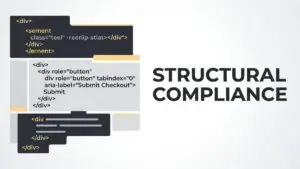
The fundamental flaw of an overlay lies in its inability to alter the foundational Document Object Model (DOM). When a screen reader parses a webpage, it interacts directly with the DOM to build a localized accessibility tree. If a developer uses a generic div tag instead of a native button element, the screen reader does not inherently know that the element is clickable. Overlays try to inject ARIA roles via JavaScript after the page loads, which frequently results in race conditions and conflicting instructions. We consistently find that this injected code degrades the user experience for individuals relying on specialized braille displays or switch controls.
Furthermore, these plugins often introduce severe performance penalties that harm overall search engine optimization metrics. A heavy JavaScript payload must execute before the overlay can even begin attempting to fix the non-compliant code. This delay creates a poor core web vital score, penalizing the website in organic search rankings while still failing to provide a legally defensible accessibility framework. By removing the widget and engineering the core code correctly, we solve both the accessibility mandate and the performance bottleneck simultaneously.
The Evaluate and Audit Remediation Process
To permanently resolve the legal threat, we initiated our Evaluate and Audit service to document every technical deficiency. We approach web development with the rigor of structural engineering, applying German Precision to ensure accessibility serves as a foundational code requirement rather than a cosmetic afterthought. Our team disabled the third-party overlay and began a meticulous examination of the raw DOM structure. This data-driven analysis provided a clear blueprint for bringing the site into strict alignment with WCAG 2.2 AA standards. We documented over two hundred distinct structural errors that required immediate developer intervention.
The audit uncovered severe structural issues that automated tools could never repair. For example, the primary navigation menu relied entirely on mouse-hover events triggered by JavaScript, making it invisible to screen readers. Furthermore, product images lacked descriptive alt text, and custom dropdown menus were built using non-semantic div tags instead of standard HTML select elements. We mapped each of these technical failures to specific WCAG success criteria to guide the remediation phase. This methodical tracking ensures that every legal claim is countered with concrete, verifiable code updates.
Engineering Compliance Through Native Code
We executed a comprehensive remediation strategy focused entirely on native code adjustments. By replacing generic container elements with semantic HTML5 tags like nav, main, and aside, we immediately improved the way screen readers parse the page hierarchy. This structural overhaul ensures that assistive technologies can build an accurate accessibility tree for the user. Our methodology guarantees that the code itself dictates the user experience, eliminating the need for fragile third-party scripts. The result is a robust, lightweight interface that functions predictably across all modern assistive devices.
Complex interactive components require precise ARIA implementation to function correctly for disabled users. We restructured the client custom modal windows to include aria-modal attributes and managed focus states so that keyboard users would not lose their place on the page. We also added aria-expanded attributes to all accordion elements, providing real-time feedback to screen readers when content state changes. These exact engineering practices are what actually protect businesses from mootness dismissals and ongoing legal scrutiny. We do not guess at compliance; we engineer it directly into the application layer.
Navigating the 2026 DOJ Title II Standards
While private businesses currently operate under Title III of the Americans with Disabilities Act, the impending 2026 DOJ Title II updates establish a critical benchmark for the entire industry. The Department of Justice has explicitly adopted WCAG 2.1 AA as the technical standard for state and local government websites. Courts consistently look to these federal mandates when determining compliance requirements for the private sector. By engineering our client website to meet or exceed these exact standards, we insulated them against both current Unruh Act claims and future federal shifts. This proactive engineering approach acts as an impenetrable shield against aggressive litigation tactics.
Relying on an overlay in this strict regulatory environment is a profound structural liability. Legal precedents increasingly demonstrate that widgets do not constitute equivalent facilitation for disabled users. Only a website built on a foundation of accessible code can withstand the scrutiny of modern compliance audits. We ensured the client understood these legal mandates, backing our technical recommendations with concrete data and recent case law trends. Businesses that fail to grasp this reality will continue to face targeted lawsuits regardless of how many superficial widgets they install.
Leveraging the IRS Section 44 Tax Credit
Structural remediation requires a financial investment, but federal tax incentives exist to ease this burden for eligible businesses. We guided our client to explore the IRS Section 44 Disabled Access Credit, which covers specific expenses related to making a business accessible. This tax credit can offset up to fifty percent of eligible expenditures, capped at five thousand dollars, for native code updates and professional accessibility audits. By leveraging this federal program, the client significantly reduced the total cost of their legal defense and technical overhaul. This financial mechanism proves that structural web compliance is an accessible goal for smaller enterprises.
Automated overlay vendors rarely discuss these financial mechanisms because their subscription models do not qualify as permanent structural improvements. The IRS credit is designed for actual remediation efforts that permanently remove barriers for disabled individuals. By choosing our Evaluate and Audit service, the client secured a tangible asset in the form of legally compliant code. This approach transforms accessibility from a recurring legal expense into a subsidized infrastructure upgrade. The return on investment becomes immediately apparent when a business successfully neutralizes a potentially devastating ADA lawsuit.
Sustaining Accessibility and Defenses
Achieving compliance is a significant milestone, but maintaining that status requires ongoing vigilance as web content changes. We established a rigorous maintenance protocol for the client, ensuring that new product uploads and marketing pages adhere to the same strict WCAG guidelines. Our team integrated automated testing pipelines into their deployment process to catch semantic errors before they reach production. This proactive stance ensures that their ADA overlay litigation risk remains permanently eliminated. Continuous monitoring is the only logical defense against code regression and future legal claims.
A transparent, data-driven partnership is essential for long-term digital accessibility success. We empower our clients by explaining technical DOM concepts in precise language, bridging the gap between raw code and user experience. If your business relies on a plugin and you are concerned about legal exposure, it is time to seek professional engineering guidance. You can get my free website audit today to begin your journey toward true structural compliance. We deliver the technical clarity and legal protection your digital infrastructure demands.
Frequently Asked Questions
Do overlays protect against Unruh Act lawsuits?
Automated overlays do not provide legal protection under the Unruh Civil Rights Act or the ADA. Because these tools fail to resolve foundational code errors within the Document Object Model (DOM), plaintiffs can still easily document WCAG violations. Structural remediation of the underlying codebase remains the only viable strategy to eliminate legal exposure.
What is the IRS Section 44 credit?
The IRS Section 44 Disabled Access Credit is a federal tax incentive for eligible small businesses that invest in accessibility improvements. This credit allows companies to offset costs associated with native code remediation and professional accessibility audits. Utilizing this credit requires genuine infrastructure upgrades rather than ongoing subscriptions to cosmetic plugins.
How does semantic HTML improve accessibility?
Semantic HTML uses standardized tags like buttons and navigation elements to explicitly define the structure of a webpage. Screen readers depend on these native tags to accurately communicate the layout and available interactions to visually impaired users. When developers build with semantic precision, they inherently reduce the need for complex, fragile ARIA attributes.