Small businesses across Southern California are currently facing an unprecedented wave of digital accessibility litigation. The recent surge in ADA demand letters is not merely a passing trend, but a calculated legal strategy rooted in the strict enforcement of the Unruh Civil Rights Act. Plaintiff attorneys are deploying automated scanners to identify websites that fail to meet Web Content Accessibility Guidelines (WCAG) 2.1 and 2.2 AA standards. These automated tools ignore superficial fixes and look directly at the underlying code structure of your digital presence. When we analyze the technical origin of these lawsuits, it becomes immediately clear that structural web compliance is the only viable defense.
Table of Contents
- The Mechanics of ADA Demand Letters
- Why Automated Overlays Fail the DOM Test
- Navigating Form Accessibility Under WCAG
- Structural Code Compliance Explained
- Leverage the IRS Section 44 Tax Credit
- The Necessity of Continuous Monitoring
- Protect and Maintain Your Digital Assets
The Mechanics of ADA Demand Letters
The legal landscape in California dictates that any website functioning as a place of public accommodation must provide equal access to users utilizing assistive technologies. ADA demand letters typically arrive after a plaintiff firm has captured concrete evidence of structural failures within the Document Object Model (DOM) of your website. They meticulously document missing ARIA (Accessible Rich Internet Applications) labels, improper heading hierarchies, and keyboard trapping issues that prevent navigation without a physical mouse. These technical logs serve as incontrovertible proof that the website fails to meet the baseline accessibility thresholds required by state and federal law.
Because the Unruh Civil Rights Act allows for substantial statutory damages per individual violation, these technical oversights rapidly translate into severe financial liabilities. Businesses attempting to resolve these issues through simple mootness dismissals often find that without altering the fundamental code base, they remain vulnerable to subsequent lawsuits. We see firms repeatedly targeted because their underlying digital infrastructure was never actually repaired. A superficial settlement agreement does absolutely nothing to correct the structural HTML deficiencies that triggered the initial legal action.
Why Automated Overlays Fail the DOM Test
Many organizations attempt to mitigate their legal exposure by installing one-click accessibility overlay plugins. These tools inject JavaScript code designed to alter the user interface dynamically, but they fundamentally fail to restructure the underlying DOM framework. Because screen readers parse the raw HTML tree rather than the superficial overlay script, users who rely on assistive technologies still encounter significant structural barriers. When a visually impaired user attempts to navigate a complex form without semantic HTML markup, the overlay cannot artificially generate the required contextual relationships.
Consequently, these quick-fix widgets leave your business fully exposed to litigation because they fail true assistive technology testing. Courts have increasingly recognized that if an overlay requires a user to activate a specialized widget just to access basic information, it creates a separate but unequal digital experience. Plaintiff attorneys specifically target websites utilizing these plugins because they serve as a visible indicator that the core code remains fundamentally inaccessible.
Navigating Form Accessibility Under WCAG
Forms represent the most critical interaction points on any website, serving as the primary mechanism for lead generation and e-commerce transactions. When a business relies on visually implied relationships rather than programmatic labels, screen reader users cannot determine what information belongs in which input field. Wrapping a text input in a native label element or explicitly linking them via specific ID attributes is a non-negotiable structural requirement. Without these programmatic associations, a visually impaired user navigating your contact form will simply hear an unhelpful audio prompt without any context regarding what data to provide.
Furthermore, WCAG 2.2 AA introduced new requirements such as the redundant entry criterion, which mandates that users should not have to enter the same information twice. This specific technical requirement forces developers to maintain robust state management across complex checkout flows and application portals. If a user inputs their billing address, the system must either auto-populate the shipping address or provide a simple mechanism to duplicate the data structurally. Relying on an overlay widget to handle these complex DOM interactions is technically impossible, as the widget cannot access your backend session data securely.
Structural Code Compliance Explained
To achieve genuine compliance, we must approach web development through the lens of structural engineering and absolute precision. Proper accessibility dictates that every interactive element possesses distinct roles, states, and properties defined directly within the HTML payload. We utilize strict semantic HTML to guarantee that screen readers and keyboard navigation protocols interpret the digital environment accurately. Creating a custom interface without the correct ARIA attributes renders it completely invisible to screen reading software, effectively locking users out of your digital storefront entirely.
Technical Code Examples for Accessibility
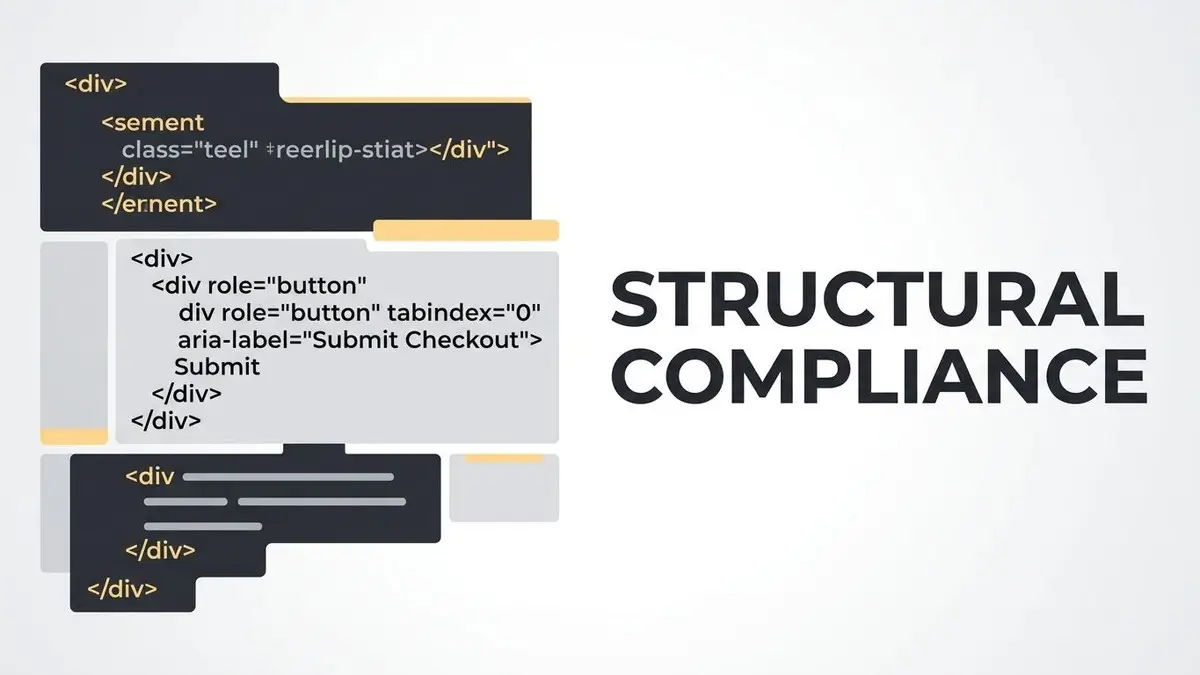
Consider a common scenario where a developer uses a generic division tag to create a button for submitting a checkout form. A standard division block lacks native keyboard focus capabilities and does not communicate its functional purpose to a screen reading API. A structurally compliant approach requires applying precise attributes to define the role and focus state: <div role="button" tabindex="0" aria-label="Submit Checkout">Submit</div>. This specific DOM structure guarantees that the browser natively understands the element’s purpose and translates that data directly to the assistive technology, ensuring a seamless user experience.
Leverage the IRS Section 44 Tax Credit
While rebuilding a website to meet rigorous accessibility standards requires an upfront investment, the federal government offers significant financial incentives to offset these technical costs. The IRS Section 44 Disabled Access Credit provides eligible small businesses with a tax credit that covers a substantial portion of structural accessibility modifications. This is not a standard deduction but a direct credit against your tax liability, making proper compliance far more manageable from a financial perspective. By investing in foundational code improvements, businesses can leverage this credit to create a structurally sound platform.
Financial planning combined with structural engineering allows businesses to transform a perceived legal burden into a strategic asset. When you utilize the IRS Section 44 provisions correctly, you are essentially redirecting tax dollars toward upgrading your digital infrastructure. This financial leverage enables small businesses to implement the same high-level technical compliance standards utilized by major enterprise corporations.
The Necessity of Continuous Monitoring
Websites are not static entities; they evolve constantly as new content, products, and marketing landing pages are published. A website that meets WCAG 2.2 AA standards today can easily fall out of compliance tomorrow if an employee uploads an image without proper alternative text. The impending 2026 Department of Justice Title II updates underscore the reality that digital accessibility requires ongoing maintenance and technical oversight at the highest levels. Automated scanners can only detect a fraction of these emerging issues, meaning manual testing by trained accessibility engineers remains an absolute necessity.
When structural code degrades over time, the risk of litigation returns almost immediately. Plaintiff firms run scheduled scans on previous targets to verify if compliance has been maintained following initial remediation efforts. If your engineering team is not proactively auditing the DOM structure during every content update, you are accumulating massive technical debt. We approach this ongoing requirement with the same analytical rigor applied to backend server maintenance or database security protocols.
Protect and Maintain Your Digital Assets
To safeguard your digital assets against ongoing legal threats, we have engineered comprehensive Protect and Maintain plans tailored for businesses. These structured maintenance protocols involve rigorous manual audits, ongoing DOM testing, and continuous code-level remediation to ensure your platform remains structurally sound over time. We reject the false security of automated overlays and instead provide the engineering precision required to meet strict legal mandates. If you are ready to secure your digital infrastructure against predatory litigation, we encourage you to Claim my free audit & roadmap today.
Our team will analyze your current code architecture and provide a factual, data-driven path toward true structural accessibility. Alternatively, you can request that we Fix my website directly to resolve foundational vulnerabilities before a plaintiff firm exploits them. True compliance is an ongoing commitment to structural integrity, and we are fully prepared to act as your dedicated technical partner.