Manual vs Automated Website Accessibility Auditing Methods
As digital environments become the primary interface for commerce and government services, organizations face mounting pressure to evaluate their website accessibility auditing methods with technical precision. The current legal landscape, shaped heavily by the impending 2026 Department of Justice Title II updates and aggressive enforcement under the California Unruh Civil Rights Act, demands that we treat digital compliance as a foundational engineering requirement. Businesses can no longer afford to rely on superficial fixes or assumed compliance when plaintiff firms systematically target non-compliant Document Object Model (DOM) structures. We must analyze the fundamental differences between automated accessibility scanning tools and manual screen-reader testing to understand how each approach impacts structural code compliance and legal exposure.
The distinction between automated scanning and manual inspection is not merely a preference in workflow, but a critical legal distinction that determines a platform’s true defensibility. When a lawsuit alleges a failure to provide equal access, the court evaluates the functional experience of the disabled user, which is intrinsically tied to the exact semantic HTML delivered to their browser. Automated parsers fail to simulate this human experience, creating a dangerous blind spot for developers who assume a clean scan equates to a legally compliant user interface. Therefore, establishing a rigorous testing protocol is the only way to ensure that digital properties do not become expensive liabilities.
Flaws in Automated Website Accessibility Auditing Methods
Automated testing software provides a deceptive sense of security for organizations attempting to meet Web Content Accessibility Guidelines (WCAG) 2.1 and 2.2 AA standards. These automated scanners operate by parsing a page’s DOM to identify missing attributes, such as empty alt text fields or missing form labels, which represent only the most basic level of accessibility engineering. Industry data consistently demonstrates that automated tools can only detect approximately twenty to thirty percent of actual WCAG violations present within a given codebase. This limitation exists because algorithms cannot evaluate the contextual accuracy of semantic HTML or determine if an Accessible Rich Internet Applications (ARIA) label accurately describes the functional state of a dynamic user interface element.
Consider the technical requirement of providing text alternatives for non-text content, which is a frequent target in federal compliance audits. An automated crawler will detect the presence of an alt attribute on an image tag and immediately mark it as compliant, regardless of whether the text string actually conveys the purpose of the image to a screen reader user. If the developer inputs redundant or meaningless text, the automated system lacks the cognitive ability to flag this structural failure. Consequently, organizations relying exclusively on automated scans remain fundamentally exposed to ADA litigation because their core structural liabilities remain undetected and unresolved.
Why Overlays Fail Assistive Technology Tests
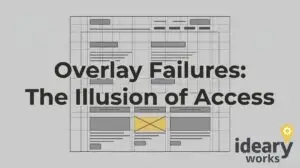
The marketplace is currently saturated with automated accessibility overlays that promise instant compliance through JavaScript injection, yet these tools represent a significant structural liability. One-click plugins attempt to dynamically modify the user interface on the client side, but they fundamentally fail to alter the underlying DOM structure that native screen readers rely upon. When a user navigates a site utilizing JAWS or NVDA, the screen reader interacts directly with the semantic HTML provided by the server, often bypassing or conflicting with the superficial changes generated by the overlay. This architectural disconnect creates a disjointed user experience where keyboard navigation focus states are trapped or announced incorrectly, ultimately leaving the business legally vulnerable.
Plaintiff attorneys are acutely aware of these technical shortcomings, frequently citing the presence of accessibility overlays as prime evidence of willful non-compliance in federal ADA complaints. From a structural engineering perspective, applying an overlay is akin to placing a piece of tape over a crack in a foundation, as it does absolutely nothing to reinforce the integrity of the underlying code. True compliance requires deliberate architectural decisions, ensuring that the markup inherently supports accessibility application programming interfaces built into modern operating systems. Until the primary semantic HTML is corrected at the server level, the business continues to operate with a high degree of legal risk.
Structural Rigor in Manual Auditing Procedures
To achieve verifiable compliance and provide a functional user experience, engineering teams must implement manual testing protocols that treat accessibility as a core architectural requirement. Manual auditing involves human experts utilizing the same assistive technologies that individuals with disabilities rely on daily, such as screen readers, switch devices, and keyboard-only navigation techniques. This hands-on approach allows auditors to evaluate the logical reading order of a page, ensuring that the visual presentation aligns perfectly with the programmatic DOM structure. When we navigate complex elements like dynamic modal windows or custom dropdown menus, manual testing confirms that focus management is handled securely and that ARIA live regions announce state changes appropriately.
This level of technical validation is simply impossible to replicate with automated algorithms, making manual inspection the definitive method for verifying WCAG 2.1 and 2.2 AA compliance. For example, testing a multi-step checkout form with a keyboard requires an auditor to verify that focus indicators are visible and that error messages are programmatically tied to their respective input fields using aria-describedby labels. If the keyboard focus vanishes during a critical transaction step, the auditor documents this exact failure point so developers can repair the focus management logic. This systematic, data-driven approach mirrors the rigor of software regression testing, guaranteeing that all accessibility features perform flawlessly in production environments.
Translating WCAG Requirements to DOM Structure
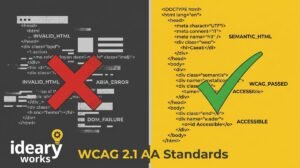
Implementing accessible web architecture requires specific semantic HTML implementations that directly dictate the behavior of assistive technologies. For instance, creating a compliant navigation system demands the use of the native HTML5 navigation element combined with appropriate aria-expanded and aria-controls attributes on toggle buttons to communicate their state to screen readers. If a developer mistakenly utilizes a generic division tag with a JavaScript click handler instead of a native button, keyboard users lose the ability to activate the element using the enter or space keys. Manual testing identifies these structural coding errors by forcing the auditor to interact with the interface strictly through a keyboard, exposing the exact points where the semantic integrity breaks down.
Another highly technical area that demands manual inspection is the proper implementation of data tables versus presentation tables. When tabular data is presented without the correct header tags and scope attributes, a screen reader cannot announce the relationship between a data cell and its corresponding row or column header. An automated scanner might verify that a table tag exists, but only a human auditor traversing the grid with NVDA can confirm that the data matrix is actually comprehensible. By grounding our development practices in this type of precise code analysis, we ensure that every element functions predictably across all major assistive technology platforms.
ADA Litigation Trends and Legal Defensibility
The surge in litigation under the Unruh Civil Rights Act across California illustrates exactly why technical web development must be prioritized over cosmetic accessibility fixes. We are witnessing a clear trend where courts dismiss mootness arguments from defendants who attempt to resolve ADA claims simply by installing automated overlays or running basic scanner tools after a lawsuit is filed. Legal defensibility requires documented evidence of structural code compliance, proving that the website’s DOM fundamentally supports the WCAG requirements outlined in the plaintiff’s complaint. Without comprehensive audit logs detailing exact semantic HTML remediation, businesses face an uphill battle in proving their digital properties are truly accessible.
When an organization can demonstrate that their engineering team conducts regular, manual screen-reader testing and resolves semantic HTML errors at the source code level, they possess a robust defense against predatory litigation. This proactive, engineering-first mentality is the only reliable method for navigating the complex federal legal landscape and protecting the business from costly statutory damages and attorney fees. Courts are increasingly demanding technical affidavits that explain how specific codebase adjustments directly correlate to improved user experiences for disabled plaintiffs. Therefore, investing in structural auditing procedures is not just an operational expense, but a fundamental risk management strategy.
Integrating Audits and the IRS Section 44 Credit
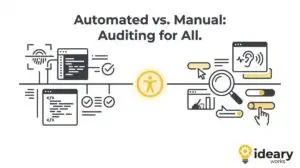
Organizations must adopt a hybrid approach that utilizes automated scanning for initial baseline diagnostics while relying heavily on comprehensive manual auditing for deep structural validation. This methodology aligns with the German Precision required for enterprise-grade web development, ensuring that accessibility is woven into the fabric of the codebase rather than treated as a post-deployment afterthought. To offset the financial investment required for this level of technical rigor, eligible businesses should leverage the IRS Section 44 Disabled Access Credit, which provides significant tax advantages for expenditures related to ADA compliance improvements. These tax credits are specifically designed to help small businesses cover the costs of legitimate technical remediation, including manual audits and codebase reconstruction.
By utilizing these financial resources to fund genuine code-level remediation, companies can permanently eliminate their structural liabilities and provide an equitable digital experience for all users. Relying on verified engineering practices rather than automated shortcuts allows business leaders to confidently deploy their digital assets without the constant fear of legal reprisal. We strongly encourage organizations to prioritize their foundational architecture and request a free website audit to begin the process of identifying their true compliance gaps. Establishing this technical baseline is the critical first step toward achieving total structural compliance and long-term digital sustainability.