Public Sector Municipal Website Accessibility Case Study
The April 2026 Department of Justice Title II updates represent a definitive legal shift, transforming municipal website accessibility from a set of suggested best practices into an enforceable federal mandate. Local governments throughout Southern California must now recognize that structural web engineering is the only acceptable method for meeting WCAG 2.1 and 2.2 AA standards. We view this transition not as a mere legal burden, but as an opportunity to apply precise technical rigor to civic platforms that serve millions of diverse residents. When digital infrastructure is engineered with the same structural gravity as physical public buildings, organizations effectively eliminate their legal exposure while drastically improving the end-user experience.
The Legal Reality for Civic Websites
California civic entities face unique, compounding pressures due to a massive localized surge in Unruh Civil Rights Act litigation alongside intensifying federal scrutiny. When civic portals fail to provide equal access to essential services like utility billing or public meeting agendas, they explicitly violate the core tenets of the Americans with Disabilities Act. The resulting legal exposure frequently ends in costly settlements, mandated consent decrees, and highly publicized remediation timelines. A data-driven approach to technical web development provides the only reliable defense against these compliance liabilities, allowing municipalities to secure mootness dismissals based on irrefutable code evidence.
The modern judicial system no longer accepts vague promises of future accessibility enhancements or superficial interface modifications. Federal courts and private plaintiffs systematically utilize automated web crawlers to identify exact WCAG violations, scanning directly for missing semantic tags or inadequate contrast ratios within the Document Object Model. Consequently, legal compliance requires a verifiable, systemic overhaul of the website architecture rather than relying on reactive patches applied after a demand letter is received. True protection stems from a proactive, structural mindset that embeds accessibility testing directly into the municipal software deployment pipeline.
Technical Failures of Automated Overlays
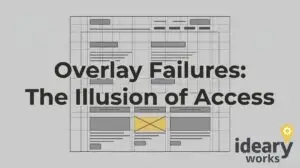
Many municipalities have historically attempted to mitigate their ADA compliance risks by purchasing automated accessibility overlays, a strategy that consistently leaves them legally and technically exposed. These third-party scripts inject JavaScript into the browser interface to present a secondary layer of accessibility options, but they completely fail to modify the underlying structural code of the website. Because overlays cannot repair a fractured Document Object Model or correct missing semantic relationships in civic data tables, they inherently fail rigorous assistive technology testing protocols. Relying on a one-click plugin rather than addressing root engineering deficiencies is a profound structural liability that fails to protect against targeted litigation.
When a citizen utilizing a screen reader attempts to navigate a site burdened by an overlay, the injected JavaScript frequently creates a severe conflict with their native assistive technology. This software collision results in skipped focus states, repeated audio announcements, and an inability to interact with vital form fields necessary for submitting civic requests. We analyze these specific failure points daily, confirming that automated solutions actively degrade the user experience for individuals who rely on precise, predictable keyboard navigation. True digital equity requires an investment in semantic HTML, proving that structural problems cannot be solved by superficial, cosmetic bandages.
Engineering Municipal Website Accessibility
Engineering municipal website accessibility requires a methodical transition away from visual-only design practices toward a strict, semantic code foundation. Modern civic portals frequently depend on complex JavaScript frameworks that load content dynamically, which can severely disorient assistive technologies if not managed with absolute precision. Implementing WCAG 2.2 AA standards mandates that developers programmatically announce these dynamic interface changes using strategic ARIA live regions, ensuring that screen readers are immediately notified when a user successfully submits a payment or triggers an error state. We enforce this standard across all structural components, guaranteeing that technical accessibility dictates the visual presentation.
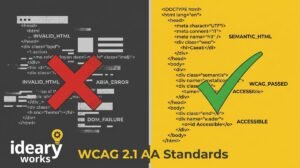
The foundation of this engineering process begins with the rigorous application of semantic HTML, a protocol that provides native, built-in accessibility without requiring complex algorithmic interventions. By utilizing standard structural tags rather than generic division elements, developers automatically grant assistive technologies the context needed to interpret the hierarchy and purpose of the webpage. This level of technical translation is absolutely critical for civic websites, where residents must quickly navigate between disparate departments, public notices, and emergency alerts. We ensure that the underlying code architecture speaks directly to the software interpreting it, eliminating the guesswork that leads to navigational failure.
Rebuilding the Document Object Model
A flawless Document Object Model serves as the essential blueprint for all assistive technology interactions, dictating exactly how a screen reader constructs its internal accessibility tree. Developers frequently make the critical error of disrupting this structural flow by placing interactive elements outside of recognized semantic landmarks, which effectively renders them invisible to keyboard navigation arrays. To rectify this common failure, we programmatically segment civic interfaces into clear, distinct navigational zones using native header, main, and footer elements. This strict separation of concerns allows users to utilize rotor menus and shortcut keys to bypass redundant navigation links and access vital civic information immediately.
Rebuilding the DOM also requires a comprehensive audit of all heading hierarchies, ensuring that logical document outlines remain fully intact. Screen reader users depend entirely on sequential heading structures to comprehend the relationship between primary public policy topics and their respective sub-sections. When engineers skip heading levels simply to achieve a specific visual font size, they destroy the structural integrity of the page and create a confusing, disjointed audio experience. We correct these structural deficiencies by separating the visual styling dictates of CSS from the semantic meaning of the HTML, applying a German precision to every node in the document.
Keyboard Navigation and Focus Management
Precise focus management represents the most critical engineering requirement for users who navigate civic portals exclusively via keyboard interfaces. Under strict WCAG guidelines, every interactive element must provide a highly visible focus indicator, confirming exactly which button or link currently holds the user’s navigational control. We design these focus rings with mathematically verified contrast ratios, ensuring that users with low vision can easily track their progression through complex multi-step government forms. Failing to manage this focus algorithmically traps users in endless navigational loops, effectively barring them from participating in digital civic life.
Furthermore, developers must engineer functional skip navigation links that act as structural bypass mechanisms for repetitive header content. Without these hidden, yet keyboard-focusable anchors, users with severe motor disabilities are forced to manually tab through dozens of irrelevant menu items before reaching the primary content of a city council agenda. We program these skip links to manipulate the browser focus state directly, transferring control seamlessly to the main content container without triggering unintended page reloads. This precise manipulation of the browser focus API demonstrates how deep technical compliance significantly reduces the physical effort required to browse municipal websites.
Advanced ARIA for Civic Data Tables
Public transparency laws require municipalities to publish massive datasets, presenting a unique challenge for structural web accessibility. Translating a comprehensive financial spreadsheet into a structurally compliant web format demands the rigorous application of semantic table headers, scope attributes, and precise caption elements. When an individual utilizing a screen reader navigates complex tabular data, the software relies entirely on these specific structural indicators to correlate data cells with their respective row and column headers. By engineering these data presentations with exact technical precision, local governments ensure that all citizens possess equal capability to scrutinize public records.
The misuse of Accessible Rich Internet Applications (ARIA) attributes often creates more severe barriers than providing no accessibility enhancements at all. Developers frequently apply custom ARIA roles to native HTML elements that already possess inherent semantic meaning, resulting in redundant or conflicting announcements for users relying on assistive technologies. Instead of attempting to force generic container elements to behave like buttons through complex JavaScript event listeners, engineers must utilize native semantic tags that natively support keyboard event handling. This structural discipline ensures that interactive elements broadcast their name, role, and value accurately to all accessibility software.
Data-Driven Outcomes and Analytics
The tangible results of deploying structurally sound civic platforms are measurable, irrefutable, and highly protective against ongoing ADA litigation. Following a comprehensive codebase overhaul, Southern California municipalities consistently report a massive reduction in targeted legal demand letters from serial plaintiffs. Furthermore, analytics indicate significant decreases in citizen support calls regarding website usability, proving that semantic HTML directly correlates with improved user autonomy and satisfaction. We track these compliance metrics rigorously, utilizing data-driven insights to validate that the engineering investment translates into functional, legal, and operational superiority.
While public sector entities do not pay federal income taxes, the extensive network of private contractors and local businesses integrated into civic portals face identical compliance mandates. These commercial partners can leverage the IRS Section 44 Disabled Access Credit to subsidize the cost of bringing their integrated software modules up to WCAG 2.1 AA standards. By ensuring that third-party payment gateways and permit portals share the same structural integrity as the primary municipal website, the entire digital ecosystem becomes unified under a single, compliant architecture. This comprehensive strategy eliminates the legal vulnerabilities frequently introduced by non-compliant external vendors.
Achieving Structural Code Compliance
Achieving verifiable digital equity requires a complete paradigm shift away from reactive, cosmetic fixes toward proactive, foundational engineering. Municipalities must embrace the reality that ADA compliance is an ongoing technical standard, demanding rigorous code analysis during every phase of the software development lifecycle. Organizations that delay this transition until the 2026 Department of Justice deadline will inevitably face severe development bottlenecks and compounded legal exposure. To begin assessing your structural vulnerabilities, we strongly advise technical leadership to Claim my free audit & roadmap immediately.
True accessibility is a permanent structural commitment that elevates the standard of digital public service for every citizen. The process of auditing, refactoring, and verifying a legacy codebase demands specialized technical oversight and an uncompromising dedication to WCAG criteria. Local governments cannot afford to gamble their public budgets on flawed automated plugins or superficial design updates that fail legal scrutiny. When you are ready to implement a permanent, data-driven solution, we are prepared to Fix my website and secure your digital infrastructure for the future.