The True Cost of Digital Accessibility Lawsuits in California
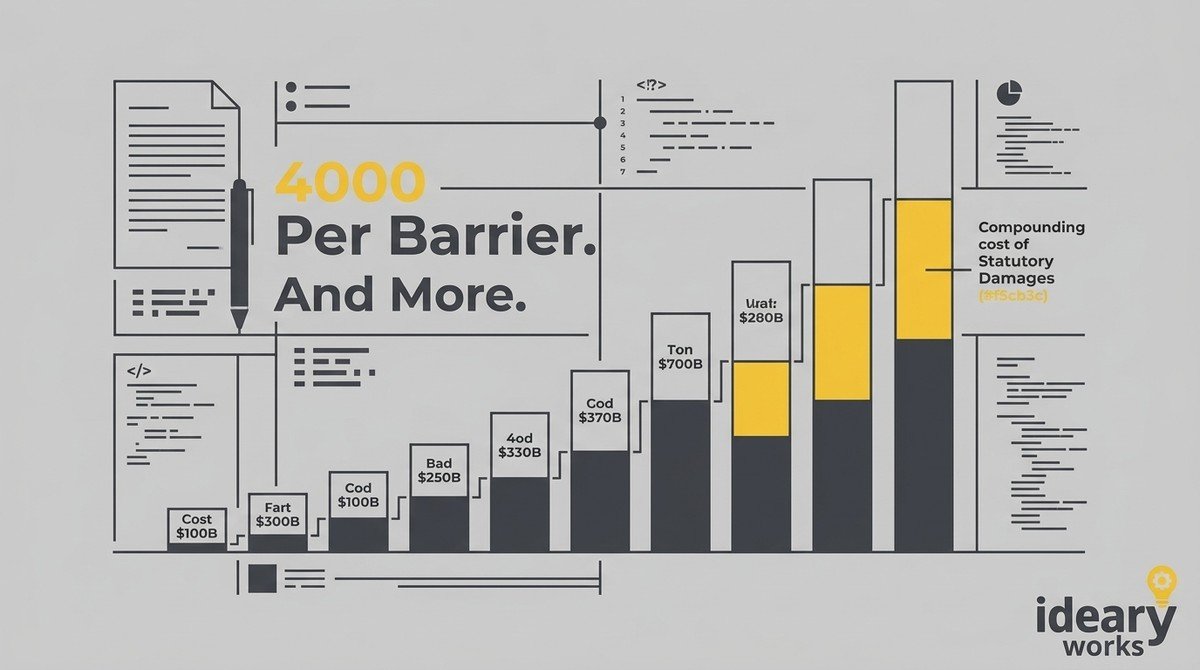
The surge in California digital accessibility lawsuits has transformed website compliance from a best practice into a mandatory structural engineering requirement. Under the Unruh Civil Rights Act, plaintiffs can claim statutory damages of four thousand dollars per access barrier encounter, which quickly compounds when evaluating complex web properties. At Ideary Works, we observe that businesses often miscalculate the true financial exposure of these legal challenges. The actual cost encompasses not only plaintiff settlements but also substantial defense attorney fees, emergency remediation costs, and lost operational revenue.
Financial Impact of Digital Accessibility Lawsuits
The financial ramifications of digital accessibility lawsuits extend far beyond the initial demand letters issued by plaintiff firms. Legal defense costs for a standard ADA Title III and Unruh Act claim in California typically range from fifteen thousand to fifty thousand dollars before a case even reaches trial. Furthermore, businesses are still legally obligated to fix the inaccessible code after paying settlements, effectively doubling the financial burden. Proactive structural development is the only objective method to mitigate these liabilities and protect your operational budget.
Fortunately, the federal government offers financial mechanisms to assist businesses in absorbing the costs of structural compliance. The IRS Section 44 Disabled Access Credit allows eligible small businesses to claim a tax credit for fifty percent of eligible access expenditures, up to a maximum credit of five thousand dollars annually. This credit can be applied directly to the engineering costs associated with remediating inaccessible web architecture. By leveraging this tax code, companies can offset the investment required to secure an authoritative digital accessibility evaluation.
Why Automated Overlays Fail Under Scrutiny
Automated accessibility plugins are frequently marketed as quick solutions for legal compliance, but they consistently fail to withstand technical scrutiny during litigation. These tools utilize JavaScript overlays that attempt to dynamically alter the user interface without restructuring the underlying Document Object Model. Because they do not modify the raw structural code, they fail to provide genuine accessibility for advanced screen readers or complex keyboard navigation paths. Consequently, deploying an overlay leaves the fundamental architectural liabilities intact, meaning businesses remain fully exposed to litigation despite paying for third-party software.
Plaintiffs and their legal counsel utilize sophisticated testing methodologies that immediately expose the superficial nature of overlay tools. When an assistive technology device interacts with an overlay, it often encounters conflicting ARIA labels, broken semantic structures, and inaccessible interactive elements. This creates a highly documented trail of Web Content Accessibility Guidelines failures that plaintiff attorneys use as concrete evidence in court. Our technical teams replace these fragile plugins with robust semantic HTML to ensure verifiable compliance across all devices.
Structural Requirements for WCAG 2.1 and 2.2 AA
Achieving verifiable compliance requires strict adherence to WCAG 2.1 and 2.2 AA requirements at the foundational code level. When developers rely on generic division elements instead of semantic HTML, they strip the interface of its intrinsic meaning. A button constructed from a basic division element lacks the native keyboard focus and activation behaviors required by statutory guidelines. To rectify this structural failure, engineers must inject specific focus management properties and ARIA roles to manually recreate what native HTML handles automatically.
Consider the implementation of accessible navigation menus, which frequently serve as the basis for legal action in California. A compliant navigation structure must utilize the semantic navigation tag alongside unordered lists to establish a clear hierarchy for screen readers. Furthermore, drop-down menus require precise ARIA expanded attributes that toggle dynamically based on user interaction to communicate the state of the interface. We implement these architectural standards with absolute precision, ensuring that the structural tree communicates flawlessly with assistive technologies.
Validating Focus States and Keyboard Navigation
Keyboard navigation and focus management represent another critical vector for legal exposure in the California jurisdiction. WCAG criteria dictate that all interactive elements must possess a highly visible focus state, allowing sighted keyboard users to track their location within the interface. Browsers provide default focus rings, but developers often disable them for aesthetic reasons without providing an accessible alternative. Reinstating persistent, high-contrast focus indicators is a non-negotiable engineering mandate for defending against modern accessibility litigation.
Screen Reader Semantics and ARIA Implementation
Forms and error identification often serve as the primary triggers for plaintiff litigation due to their structural complexity. Under current WCAG standards, it is no longer sufficient to merely indicate an error with a red border or a generic text warning. The DOM structure must programmatically link the error message to the specific input field using the ARIA described-by attribute, ensuring that screen readers announce the exact problem when the user focuses on the field. This level of technical translation bridges the gap between raw code and user experience, providing a defensible layer of compliance.
Defending Your Business with Structural Compliance
The regulatory landscape is becoming increasingly stringent, further elevating the risks associated with non-compliant digital architecture. The 2026 Department of Justice Title II updates mandate strict adherence to WCAG 2.1 AA for public entities, which establishes a definitive precedent for private sector Title III expectations. Courts are increasingly referencing these technical standards to define exactly what constitutes a discriminatory barrier in digital environments. As the legal definition of accessibility crystallizes around specific technical metrics, ambiguous development practices are no longer legally defensible.
The most effective strategy for managing legal risk is the pursuit of mootness dismissals through comprehensive code remediation. By demonstrably eliminating all access barriers and deploying a structurally sound web property, businesses can render pending lawsuits moot under federal law. However, this defense requires verifiable proof that the underlying DOM structure has been permanently corrected and that accessibility protocols are systematically enforced. We engineer these structural transformations to provide our clients with the empirical data needed to dismantle legal claims.
Web accessibility must be treated as a foundational code requirement rather than a cosmetic afterthought or a temporary legal burden. By adopting a mindset of structural precision, organizations can eliminate their reliance on ineffective overlays and secure their digital properties against costly litigation. We invite forward-thinking businesses to undergo a rigorous technical assessment to quantify their current level of legal exposure. To begin the process of fortifying your web architecture, you can request a structural accessibility audit today.
Frequently Asked Questions
To further clarify the complex intersection of web engineering and California civil rights law, we have compiled answers to the most pressing compliance questions. These technical insights are designed to separate actionable engineering facts from the pervasive misinformation surrounding automated compliance tools. Our objective is to empower business leaders with the data required to make sound architectural decisions.
What makes California a hotspot for digital lawsuits?
California is unique because the Unruh Civil Rights Act allows plaintiffs to claim statutory damages for every accessibility violation they encounter. Unlike federal ADA Title III cases that typically only result in injunctive relief and attorney fees, California state law provides a direct financial incentive for plaintiffs. This statutory framework transforms minor semantic HTML errors into significant financial liabilities for any business operating within the state.
Can an automated overlay protect me from an Unruh lawsuit?
Automated accessibility overlays do not alter the underlying DOM structure, meaning they fail to resolve the core architectural defects that violate WCAG standards. Plaintiff attorneys specifically target websites utilizing these plugins because their presence often indicates a lack of native structural compliance. Relying on an overlay is a technical liability that provides zero reliable legal protection during a rigorous assistive technology audit.
How do tax credits offset the cost of structural compliance?
The IRS Section 44 Disabled Access Credit provides eligible businesses with a tax credit for half of their accessibility-related expenditures up to a specific limit. This federal incentive is explicitly designed to help organizations fund the engineering labor required to achieve WCAG 2.1 or 2.2 AA compliance. By applying this credit, companies can significantly reduce the net cost of hiring a California accessibility partner to rebuild their digital infrastructure.
Does the 2026 DOJ Title II update affect private businesses?
While the 2026 Department of Justice Title II updates specifically target state and local government entities, they establish a critical technical baseline for the private sector. Courts consistently apply these identical WCAG 2.1 AA metrics when evaluating Title III claims against private businesses. Therefore, commercial enterprises must adopt these exact structural engineering standards to maintain a defensible posture in civil litigation. We mandate these strict technical guidelines across all our client projects to ensure long-term architectural stability.